Value Tuning:
The Hidden Language
of Brand Perception
Originally developed for Signify/Philips to close the gap between technical trust and emotional meaning, Value Tuning uses the senses as its instrument to adapt to wherever that distance exists: between what a brand promises and what a product delivers, between an ethical story and a sensory truth, between democratic design and the feeling of quality in your hands.
Originally developed for Signify/Philips to close the gap between technical trust and emotional meaning, Value Tuning uses the senses as its instrument to adapt to wherever that distance exists: between what a brand promises and what a product delivers, between an ethical story and a sensory truth, between democratic design and the feeling of quality in your hands.
In collaboration with

From Technical Trust, to Emotional Experience
For decades, Philips Lighting built its reputation on engineering reliability and technical excellence. But with the emergence of connected devices and the Smart Home ecosystem, the company began repositioning itself under a new name: Signify.
A brand built on technical trust and engineering reliability needed to transition into a space defined by domestic intimacy, atmosphere, and emotional experience.
This shift raised an important question:
how can physical products express this transition through their sensory qualities?
I was invited to explore the gap between inherited brand perception and the embodied experience of these new domestic technologies, design and materiality.
To do so, I developed a qualitative research methodology designed to isolate how people interpret products through touch, sound, weight, and materiality, beyond brand recognition alone.
The Value Spectrum
I proposed that there is a measurable distance between what people expect from a brand and what they actually feel when encountering its products through the senses.
This gap becomes visible in the moment where brand narrative meets embodied experience: in the weight of an object, the resistance of a hinge, the texture of a surface, the sound of opening, the order of packaging.
When expectation and sensory experience align, trust is reinforced. When they diverge, disappointment emerges. Brand value, then, does not live in image alone, but in the relationship between promise and perception.
Value Tuning operates precisely in this space, making the invisible measurable, and the measurable actionable.
Methodology Trailer
A short introduction to the research method: mapping brand expectations, removing visual bias, and evaluating products through touch, sound, weight, and material interaction.
Designed to Make the Gap Visible
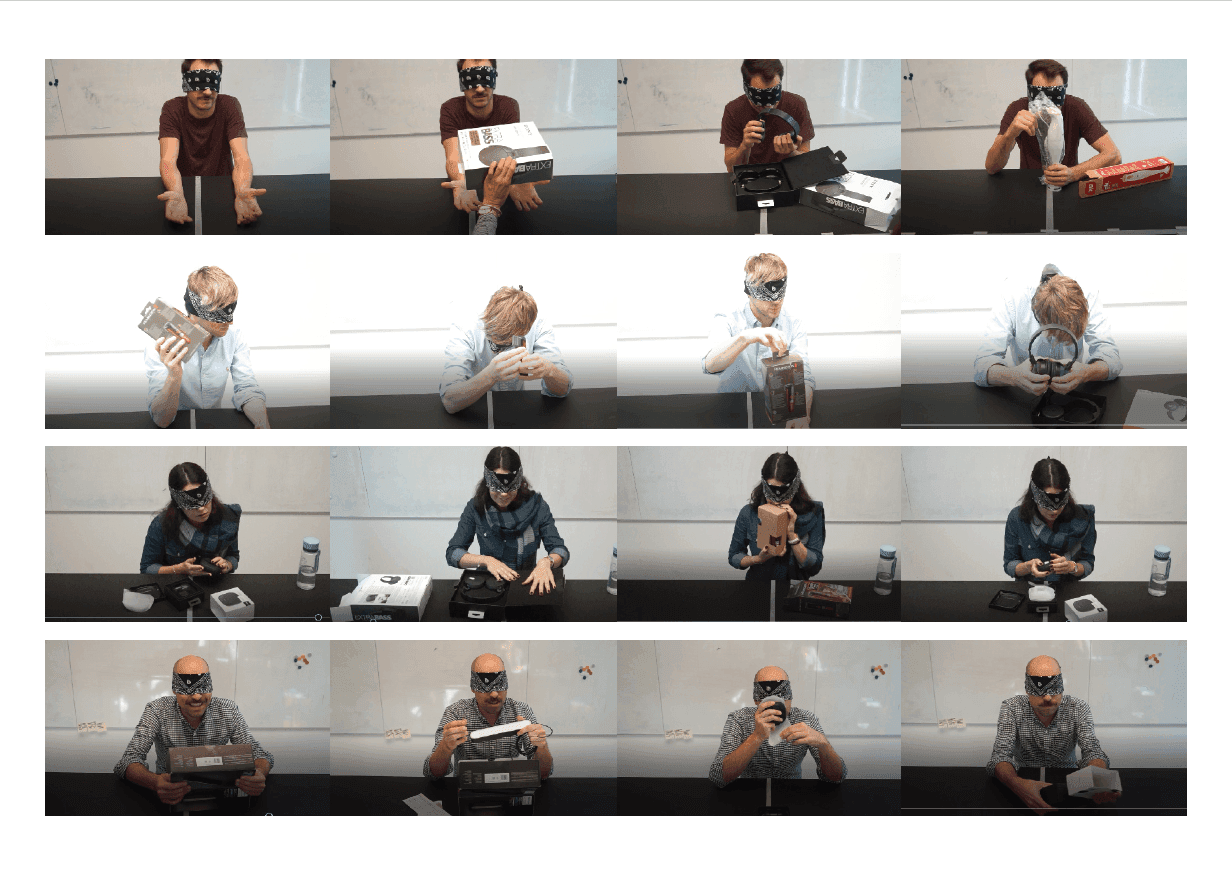
Value Tuning is a structured sensory research protocol conducted with real users, real products, and deliberately constrained conditions. It separates what people expect from a brand from what they actually feel when they encounter its products through touch, sound, weight, and materiality.
The method moves through three designed moments, each one stripping away a layer of assumption until only honest perception remains.
The output is not a qualitative impression. It is a mapped distance: between brand promise and lived material experience, rendered as a diagnostic you can act on.
The Blindfold Protocol
"The senses are not merely passive receptors of information but active participants in the construction of reality."
— David Howes, The Empire of the Senses
Visual branding wields immense power. A logo, a color palette, a carefully staged photograph. these elements prime our expectations before we ever touch a product. But this priming is also a distortion. When we see a luxury brand's packaging, we are not experiencing the object; we are experiencing the narrative we have been conditioned to associate with it.
The blindfold protocol removes this variable. By excluding sight, we access what David Howes calls the "sensory order", the hierarchy of perception that operates beneath conscious brand recognition. Touch becomes primary. Sound becomes information. Temperature, weight, and texture speak without the interference of visual bias.
Visual Bias
Logo recognition triggers pre-conditioned quality associations. We judge what we expect, not what we feel.
Narrative Conditioning
Brand storytelling creates a "halo effect" that masks sensory inconsistencies. The eye forgives what the hand cannot.
Proximal Truth
Objects close to the body—held, touched, manipulated—are judged by different criteria than objects viewed from distance.
"What feels like home? What invites the hand to linger? These questions cannot be answered through visual analysis alone. The blindfold reveals the gap between what a brand promises and what a product actually delivers to the senses."
Expectations vs. Perception
This map compares how participants positioned each brand before interacting with the object and how they positioned it again after the blindfolded sensorial test.
The distance between both judgments reveals the gap between brand promise and lived material experience. When perception falls below expectation, disappointment emerges. When perception exceeds expectation, the product creates surplus value.
Brand A
Brand A performs best in sensorial uplift. Blindfolded interaction raises perceived value, showing strong coherence between material experience and brand positioning.
Brand B
Expectations begin around the ordinary-to-average range, but tactile perception tends to fall slightly lower. The product feels more generic than the brand suggests.
Brand C
Brand C starts with the highest expectations. Perception remains high, but the brand also carries the greatest risk of slight disappointment because the promise is already so elevated.
What Users Actually Feel
Blind sensory evaluation revealed the unspoken vocabulary of quality. Users immediately sense when design intention aligns with execution, and when it doesn't.
"If they do it like this [ripping gesture], you want people to know wether it's been opened or not... I will know I am the first one to open the box."
Tamper-evident packaging creates emotional security and perceived newness. Users read packaging mechanics as a signal of care, integrity, and product freshness.
— Brand C"It's actually kind of entangled. I cannot get it out, so I have to do more... I want to get the product first, that's the most important."
Cable management and internal packaging structure directly impact first impression. Complexity signals disrespect for user time.
— Brand A"Like, it even has an echoe...Yeah, it feels.. empty to me. It doesn't feel like quality product..."
Users intuitively categorize products into tiers. Consistency matters more than absolute quality—mismatched materials create cognitive dissonance.
— Brand A"I wouldn't have this next to my bed. It reminds me of an office... the tactility of it makes me think it's a practical object and not necessarily a home object."
Material choices determine spatial belonging. Hard plastic reads 'industrial'; soft-touch reads 'domestic'. Context determines appropriateness.
— Brand A vs Brand C"This would become part of the interior [...] I could almost think of it as flowers? like taking care of it."
Seamless transitions between soft-touch fabric and hardware create objects that invite touch. Users describe these as something I can grab and play with: domestic, personal, home-worthy.
— Brand C"ah, now I have a bunch of fallen booklets - instructions.. everything is loose."
Material choices determine spatial belonging. Hard plastic reads 'industrial'; soft-touch reads 'domestic'. Context determines appropriateness.
— Brand ASix Parameters of Perceived Value
From the research, I distilled six measurable parameters that determine whether a product feels premium or falls short, regardless of its price point. These parameters form the diagnostic spine of every Value Tuning engagement.
Physicality
Transparency
Order
Stratification
Alignment
Context
The full parameter framework, scoring rubric, and design criteria are delivered as part of the audit report.
What a Value Tuning Engagement Produces
Every engagement concludes with a structured audit report tailored to your product and brand context. It includes:
- —A mapped gap analysis between brand expectation and sensory perception across your product range
- —Scored evaluation across the six Value Tuning parameters
- —Specific material, structural, and experiential friction points identified in user sessions
- —Design criteria and prioritized recommendations your team can act on immediately
- —Strategic framing to support internal conversations about quality investment
The report is designed to give designers and brand teams user-generated evidence, not just observations.
Beyond the Report
A report is the beginning, not the end.
Strategic
Positions the gap between brand promise and product reality as a measurable, actionable distance, giving leadership a new lens on where quality investment creates the most return.
Tactical
Surfaces the specific moments where perception breaks: the first touch, the opening sequence, the material encounter. Each finding maps directly to a design decision.
Political
Turns subjective experience into evidence. Designers leave with something they can defend in a room where budgets are decided.
This Is For You If...
- —You're repositioning a brand and need to know if your products are keeping pace with the new narrative
- —You're preparing a product line for launch in a premium or luxury segment
- —You sense a gap between how your brand is perceived and how your products actually feel, but can't locate it
- —Your design team needs user evidence to advocate for quality in budget conversations
In an Increasingly Digital World
We encounter brands screen-first: through images, campaigns, and carefully constructed narratives, long before we ever touch the product itself. By the time it reaches our hands, expectation is already formed.
The first physical interaction is unforgiving. A lid's weight. The temperature of a material. The resistance of a hinge. These are verdicts which instantly confirm or quietly contradict everything a brand has claimed.
Working with Signify made this visceral: even the most sophisticated technology loses its value if the first touch feels wrong. In premium contexts that gap between promise and sensation isn't perceived as nuance. It's felt as disappointment, and disappointment is expensive.
Value Tuning operates precisely at this point of tension, translating brand narrative into tangible design decisions, identifying where perception breaks, where value is lost, and where it can be amplified. Across luxury, beauty, automotive, and consumer technology, the challenge is always the same: not only to design products that function, but to ensure they feel exactly as imagined (or better).
Because value is not communicated, but verified through the 'body' of the object.
When your product is finally held, will it justify everything that came before?
Run a Value Tuning audit for your brand
Engagements run over 2–4 days and deliver a full sensory audit report with design criteria and strategic recommendations. Suited to product companies, packaging teams, and brand strategists preparing for repositioning or launch.
Each engagement is scoped to your product and context, reach out to discuss fit.
Value Tuning is an original research methodology developed by Valentina Marino at Signify (Philips), 2018–2019.
Concept, protocol design, and framework © Valentina Marino.
All rights reserved.